Relativistic Von Neumann Needle Probes
Abstract
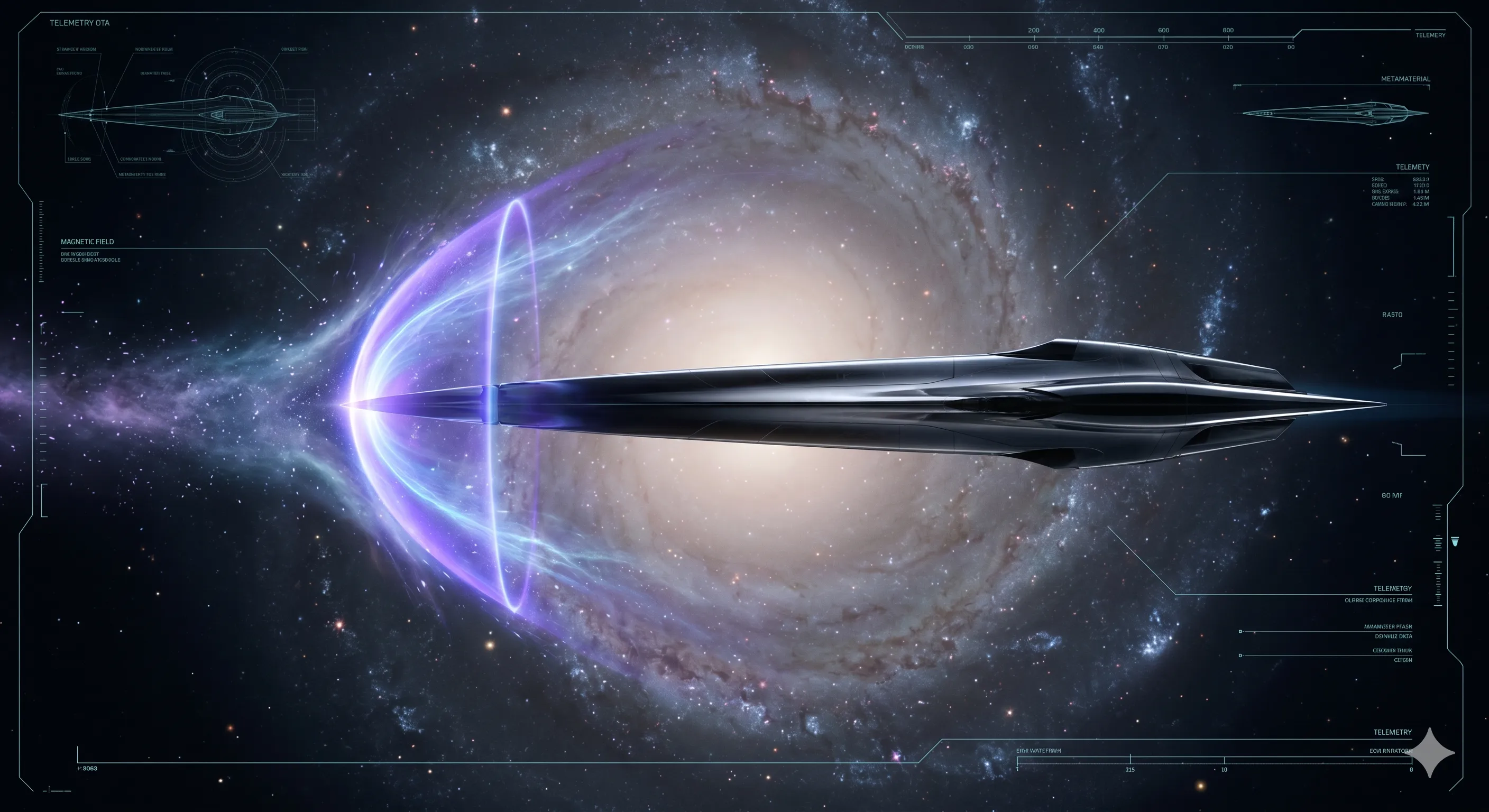
We propose a class of autonomous self-replicating relativistic probes optimized for survival, capture, and industrial bootstrapping in sparse astrophysical media. The central design concept is the Relativistic Von Neumann Needle Probe (RVNNP): a low-frontal-area seed vehicle launched by an external accelerator, cruising as a thin needle or blade to minimize particle-collision cross-section, and decelerating at the destination using a deployable magnetic/electric sail system. The probe carries neither a conventional factory nor large propellant reserves; rather, it carries a compact seed fabricator, encoded manufacturing libraries, robust autonomy, and enough bootstrapping capability to convert local minor-body resources into industrial infrastructure, launchers, and daughter probes.
We first describe general design principles independent of range. We then apply the architecture to interstellar propagation between adjacent star systems, where speeds of approximately 0.1—0.3c appear more attractive than near-c flight because they reduce energy, heating, dust damage, and braking burden while preserving useful expansion-front speed. Finally, we scale the same architecture to intergalactic propagation, where a Kardashev Type III civilization could plausibly use AU- to stellar-system-scale launchers to send kilogram-scale seeds at 0.99—0.999c over distances of order 10 million light years. In the intergalactic case, the destination target is not a star system but the future circumgalactic halo of a galaxy, where a large plasma-inflated magnetic sail can begin capture before the probe reaches the dusty stellar disk.
The resulting design is not a single vehicle but a family of mission classes sharing five principles: minimize physical collision cross-section, separate launch coupling area from cruise geometry, bypass charged/ionized particles rather than absorb them, keep large sails stowed until braking, and rely on bounded swarm replication rather than single-probe reliability.
1. Scope and Assumptions
This paper is a speculative engineering synthesis. We assume far-future technology but not arbitrary physics. In particular, we assume:
- No faster-than-light travel, inertia cancellation, reactionless propulsion, or violations of special relativity.
- Extremely advanced materials, including high-temperature metamaterials, radiation-hard logic, self-annealing structures, high-current superconductors, and long-lived cryogenic or nonvolatile information storage.
- Highly autonomous machine intelligence capable of navigation, fault recovery, scientific target selection, and industrial bootstrapping.
- External launch infrastructure much more massive than the probe. The probe is not assumed to carry the energy needed to accelerate itself to relativistic speed.
- Bounded replication. The probe is a von Neumann system in the sense of local manufacturing and reproduction, but its replication is task-limited, target-limited, and biosphere-avoidant.
- Mission design is non-hostile. Relativistic craft are kinetic hazards; therefore the proposed architecture is explicitly designed to avoid planetary impacts and to decelerate before industrial activity.
A Kardashev Type III civilization is used as the upper-scale energy assumption for intergalactic launch infrastructure. Kardashev’s original classification associated Type III civilizations with galaxy-scale energy use; the present paper uses the term in that broad sense rather than as a precise power budget.1
2. Related Concepts
Several prior concepts motivate this architecture.
Breakthrough Starshot proposed gram-scale light-sail nanocraft accelerated by beamed light to roughly 0.2c for a flyby of Alpha Centauri.2 That program is important here not because the RVNNP is identical, but because it identifies a physically coherent regime: very low mass, external energy supply, relativistic speed, and swarm deployment.
Studies of Starshot-like craft have emphasized that interstellar gas and dust can cause erosion, cratering, melting, and heavy-ion track damage even at 0.2c.3 Starshot challenge materials also identify cruise dust as a central design concern.4 These findings motivate needle geometries, sacrificial leading structures, and active particle management.
Magnetic and electric sails have been proposed as propellantless deceleration systems for interstellar missions. Perakis and Hein argued that magnetic sails are more effective at higher velocities and electric sails at lower velocities, motivating staged sail operation.5 Gros analyzed magnetic-sail braking in dilute interstellar media and emphasized the importance of area-to-mass scaling and plasma-density uncertainty.6
Self-reproducing interstellar probes were analyzed by Freitas in 1980.7 The RVNNP differs in emphasizing relativistic survival, needle-like cross-section control, and staged electromagnetic particle management, but it inherits the basic bootstrapping logic of a seed system that builds larger industry from local materials.
3. Core Design Thesis
We propose the following thesis:
A practical relativistic self-replicating probe should not be designed as a small spaceship. It should be designed as a launched seed: a collision-minimized needle body, a detachable or foldable boost interface, an active particle-bypass system, a sacrificial dust architecture, a stowed capture sail, and a bootstrapping payload capable of growing into local industry after capture.
This implies several architectural separations:
| Function | Preferred design choice |
|---|---|
| Acceleration | External launcher or beamed-power array |
| Cruise survival | Needle geometry, ionization/EM bypass, sacrificial nose |
| Cruise thermal control | Low absorption, high-emissivity side surfaces, dormant operation |
| Deceleration | Deployable magnetic/electric sail, not exposed during cruise |
| Replication | Local resource use after safe capture |
| Reliability | Many probes, varied trajectories, bounded replication |
The decisive engineering variable is effective swept area. Mass, energy, heating, collision rate, and drag scale first with the area that interacts with ambient matter. A broad light sail or magnetic sail is beneficial during launch or braking, but dangerous during high-speed cruise. The architecture therefore separates the high-area boost/capture systems from the low-area cruise body.
4. Reference Architecture
4.1 Vehicle Form
The reference RVNNP is a needle or blade-like seed vehicle. Its cruise orientation keeps the smallest dimension facing the velocity vector. The body may be cylindrical, lenticular, or knife-edged, but all variants share a small frontal cross-section.
A representative vehicle family is:
| Parameter | Micro-seed | Standard seed | Heavy seed |
|---|---|---|---|
| Cruise mass | 10—100 g | 0.1—10 kg | 10—1,000 kg |
| Length | 0.1—1 m | 1—10 m | 10—100 m |
| Frontal area | 0.001—0.1 cm² | 0.01—10 cm² | 1—1,000 cm² |
| Primary role | Reconnaissance or minimal seed | Main replication unit | Low-risk industrial seed |
| Typical use | High attrition swarms | Interstellar/intergalactic standard | Slower or high-value missions |
For most of this paper, we use a 1 kg, 1 cm² reference probe when giving order-of-magnitude calculations.
4.2 Functional Stack
We propose the following fore-to-aft functional stack:
- Sacrificial leading whisker or spike. A thermally isolated, replaceable, self-annealing, or ablative structure takes unavoidable gas and nanodust impacts.
- Forward ionizer/electron stripper. Neutral atoms are ionized before impact using UV/X-ray radiation, particle beams, plasma sheaths, or field-supported ionization curtains.
- Electromagnetic particle broom. Charged particles are routed around the body using magnetic/electric fields. The design goal is not to stop particles but to preserve most of their kinetic energy and let them miss the vehicle.
- Primary seed bus. The protected core contains logic, memory, navigation sensors, repair systems, and compact fabrication tools.
- Thermal radiator skin. The side surfaces provide high-emissivity radiation while avoiding a large forward-facing area.
- Stowed sail cartridge. Magnetic/electric sail hardware remains compact during cruise and deploys only for capture.
- Boost interface. A temporary sail, armature, or beam-coupling structure is used during acceleration, then folded edge-on, detached, ablated, or converted into shielding.
4.3 Probe Autonomy
The RVNNP requires autonomy in four domains:
- Navigation autonomy: star tracking, inertial navigation, relativistic aberration correction, and final target acquisition.
- Damage autonomy: impact localization, sacrificial-tip management, rerouting of internal systems, and self-annealing cycles.
- Capture autonomy: interpretation of local plasma density, magnetic fields, dust distributions, and sail deployment timing.
- Industrial autonomy: mining, refining, fabrication, quality assurance, launcher construction, and daughter-probe certification.
The probe is best treated as a seed for a future local civilization-like industrial node, not as a conventional spacecraft performing a fixed mission script.
5. Relativistic Scaling Laws
5.1 Kinetic Energy
The kinetic energy per unit mass is:
where
| Speed | Lorentz factor | Kinetic energy per kg |
|---|---|---|
| 0.05c | 1.0013 | 1.1×10¹⁴ J/kg |
| 0.1c | 1.0050 | 4.5×10¹⁴ J/kg |
| 0.2c | 1.0206 | 1.9×10¹⁵ J/kg |
| 0.3c | 1.0483 | 4.3×10¹⁵ J/kg |
| 0.5c | 1.1547 | 1.4×10¹⁶ J/kg |
| 0.99c | 7.0888 | 5.5×10¹⁷ J/kg |
| 0.999c | 22.366 | 1.9×10¹⁸ J/kg |
This table drives a major design conclusion: near-c velocities are energetically plausible only when launch infrastructure is enormous and probe mass is very small. For adjacent-star propagation, 0.1—0.3c is often more attractive. For intergalactic propagation, 0.99—0.999c becomes attractive because the range is millions of light years and time dilation improves onboard survivability.
5.2 Charged-Particle Deflection
A charged particle with momentum and charge has magnetic rigidity:
For protons:
| Speed | Proton magnetic rigidity |
|---|---|
| 0.2c | ~0.64 T·m |
| 0.3c | ~0.98 T·m |
| 0.5c | ~1.81 T·m |
| 0.99c | ~22 T·m |
| 0.999c | ~70 T·m |
To displace a proton sideways by distance over deflection length , a rough transverse-field estimate is:
Thus, charged-particle deflection is feasible if the field interaction region extends ahead of the probe by tens to thousands of meters. This favors a plasma-inflated or field-supported particle broom rather than a purely solid shield.
5.3 Gas Heating
In the probe frame, an approximate full-deposition gas-heating power is:
where:
- is effective collision area;
- is hydrogen number density in the rest frame of the medium;
- is a mass correction for helium and metals, taken here as ~1.4;
- is the fraction of kinetic energy deposited as heat in the vehicle.
For a 1 cm² aperture in a mean intergalactic density of , full-deposition heating is approximately:
| Speed | Full-deposition gas heating |
|---|---|
| 0.99c | 4.9×10⁻⁵ W/cm² |
| 0.999c | 5.4×10⁻⁴ W/cm² |
| 0.9999c | 5.6×10⁻³ W/cm² |
These values are small because the intergalactic medium is sparse. In the local interstellar medium, however, densities of order 0.01—0.3 cm⁻³ are plausible depending on direction and phase; heating then increases by many orders of magnitude.8
For :
| Speed | Full-deposition gas heating per cm² |
|---|---|
| 0.2c | ~0.008 W |
| 0.3c | ~0.029 W |
| 0.5c | ~0.17 W |
| 0.8c | ~1.7 W |
| 0.99c | ~81 W |
| 0.999c | ~904 W |
This is one of the strongest arguments against routine 0.99c star-to-star replication.
5.4 Radiative Cooling
Radiative heat rejection is governed by:
A small needle with of radiating area and emissivity can radiate approximately:
| Temperature | Radiated power |
|---|---|
| 20 K | 4.5×10⁻⁵ W |
| 50 K | 1.8×10⁻³ W |
| 100 K | 2.8×10⁻² W |
| 300 K | 2.3 W |
| 1,000 K | 280 W |
Global heat accumulation is therefore not the main problem in sparse media. The main thermal threat is localized flash heating from dust and high-speed passage through dense gas.
5.5 Drag from Particle Management
If the probe sweeps mass over a path and transfers axial momentum with efficiency factor , a useful estimate for cruise slowdown is:
For a 1 kg probe, 1 cm² effective area, 0.99c, mean intergalactic density, and 10 million light years, the swept gas mass is only ~4×10⁻⁹ kg. Even with , slowdown is only of order 0.1 m/s. The danger is not the narrow particle broom; the danger is accidentally deploying a broad magnetic obstacle during cruise.
5.6 Dust Impact Scaling
For a grain of radius , density , and speed , the kinetic energy is:
At 0.99c for silicate-like density :
| Grain radius | Kinetic energy |
|---|---|
| 0.01 µm | ~0.007 J |
| 0.1 µm | ~7 J |
| 1 µm | ~6.9 kJ |
| 10 µm | ~6.9 MJ |
Dust is therefore not primarily an average-heating problem. It is a localized explosive-deposition and mission-survival problem.
6. General Design Principles
Principle 1: Minimize Physical Frontal Area
We propose that collision cross-section be treated as a first-class design variable. Every square centimeter of forward area increases gas heating, dust impact probability, erosion, momentum noise, and shielding mass.
The boost sail, if used, must not remain deployed broadside during cruise. It should be detached, folded edge-on, reshaped into a narrow shield, or converted into a trailing structure.
Principle 2: Bypass Particles; Do Not Absorb Them
The optimal ionizer + EM deflector does not stop incoming particles. It changes their trajectory so they miss the body and leave carrying most of their energy. Absorbing relativistic particles converts them into heat, radiation, erosion, and secondary particles.
The particle-management system should therefore operate as a bypass chicane:
- Neutral atoms are ionized or stripped ahead of the vehicle.
- Electrons and ions are separated and guided through a hollow flow around the needle.
- Fields are shaped to reduce net charge accumulation and axial drag.
- Unavoidable residuals are handled by the sacrificial forebody.
Principle 3: Keep the Magnetic Sail Stowed During Cruise
A magnetic sail is a braking system. If deployed during cruise, it becomes a drag sail and heat/damage collector. We propose distinct field regimes:
| Regime | Effective radius | Purpose |
|---|---|---|
| Cruise particle broom | cm to m scale | Protect body while minimizing drag |
| Approach sail | km to 1,000 km scale | Begin deceleration in target medium |
| Final electric/photon sail | variable | Low-speed capture and maneuvering |
The same hardware may be reused, but the operating mode must change by many orders of magnitude.
Principle 4: Treat Dust as a Stochastic Catastrophe
Dust impacts should be managed probabilistically. The design should assume that some probes fail. A robust architecture uses:
- route planning through low-dust regions;
- extremely small frontal area;
- sacrificial nose/whisker structures;
- forward dust-vaporization beams or plasma spoilers;
- impact-tolerant distributed electronics;
- swarm redundancy.
Principle 5: Use Staged Deceleration
No single braking method is optimal across all velocities. We propose:
- High-speed braking: magnetic sail or plasma magnet in ambient ionized medium.
- Intermediate braking: electric sail, magnetic sail, and photon sail as available.
- Low-speed capture: stellar-wind sailing, photon pressure, gravity assists, compact onboard propulsion, or externally built capture aids.
Principle 6: Replicate Industry, Not Merely Probes
The seed must not only reproduce itself. It must construct a local industrial ecosystem:
- prospecting and anchoring systems;
- miners and refiners;
- power collectors and energy storage;
- fabrication plants;
- metrology and quality-control infrastructure;
- launchers and beam directors;
- daughter probes;
- observatories and environmental monitors.
Replication should be bounded by mission rules, resource limits, biosphere avoidance, and cryptographic or physically embedded authorization constraints.
Principle 7: Prefer Minor Bodies Over Planets
We propose that RVNNPs target minor bodies, debris disks, cometary reservoirs, dwarf planets, and uninhabited asteroids. Planets, especially potentially habitable planets, should be avoided until after capture, survey, and biosignature analysis.
7. Applied Design: Adjacent-System Interstellar Propagation
7.1 Mission Objective
The interstellar RVNNP expands from one stellar system to nearby systems, constructs local launch infrastructure, and repeats. The objective is not merely to cross interstellar space but to establish a durable, self-sufficient industrial node.
7.2 Preferred Cruise Speed
We propose 0.1—0.3c as the default star-to-star range.
| Speed | Time over 4.37 ly | Kinetic energy per kg | Design implication |
|---|---|---|---|
| 0.1c | 43.7 yr | 4.5×10¹⁴ J/kg | Conservative, robust |
| 0.2c | 21.9 yr | 1.9×10¹⁵ J/kg | Starshot-like speed regime |
| 0.3c | 14.6 yr | 4.3×10¹⁵ J/kg | Aggressive but plausible for advanced systems |
| 0.5c | 8.7 yr | 1.4×10¹⁶ J/kg | High damage/braking burden |
| 0.99c | 4.4 yr | 5.5×10¹⁷ J/kg | Usually unjustified for adjacent systems |
Near-c flight saves only years to decades on adjacent-star hops, but imposes much greater energy, dust, heating, shielding, and braking costs. For a self-replicating network, the industrial bootstrapping time at the destination may dominate the cruise time. Therefore, expansion-front optimization favors reliability and reproductive rate over maximum cruise speed.
7.3 Interstellar Vehicle Configuration
A representative standard interstellar seed is:
| Subsystem | Proposed specification |
|---|---|
| Mass | 0.1—10 kg standard; 10—100 g micro-seed for high-attrition swarms |
| Cruise speed | 0.1—0.3c default |
| Geometry | Needle/blade body, frontal area ~0.01—10 cm² |
| Launch coupling | Temporary light sail, microwave sail, particle-beam armature, or electromagnetic sabot |
| Cruise protection | Ionizer + EM particle broom + sacrificial nose/dust spoiler |
| Capture | Magnetic sail, electric sail, photon sail, local propulsion |
| Target | Outer minor bodies, cometary reservoirs, debris disks, asteroid belts |
| Replication | Local mining, refining, fabrication, beamer/launcher construction |
7.4 Launch Infrastructure
For adjacent systems, the launcher should be reproducible by each new node. We propose star-powered phased arrays or electromagnetic launchers built from local system resources.
A plausible sequence is:
- Build solar or fusion power infrastructure in the home system.
- Manufacture phased laser/microwave arrays or electromagnetic launch tracks.
- Launch seed probes using disposable boost interfaces.
- Track and correct outbound trajectories during early cruise.
- Reuse the same infrastructure for many launches.
A new system does not need to build a galaxy-scale launcher. It needs a repeatable star-system-scale launcher able to send many probes to the next shell of nearby stars.
7.5 Cruise Environment
The interstellar medium is much denser than the mean intergalactic medium. Interstellar gas and dust therefore dominate design. At 0.2c, an active particle broom is easier than at 0.99c because particle rigidity is lower. Dust remains dangerous because even micron-scale grains can deposit substantial local energy.
The cruise protection system should be tuned to the target path:
| Environment | Design response |
|---|---|
| Local bubble / low-density direction | Higher speed acceptable |
| Warm neutral cloud | Ionizer required for neutral H |
| Dense molecular cloud | Avoid route if possible |
| Dust-rich debris region | Slow before entry or route around |
| Stellar wind boundary | Use for final sail operations |
7.6 Braking and Capture
We propose staged braking beginning far before the target star:
- 0.1—1 ly before arrival: deploy a magnetic/plasma sail for high-speed braking against interstellar plasma.
- Outer system: transition to electric sail and photon sail where stellar wind and radiation become useful.
- System capture: use gravity assists, compact propulsion, or externally seeded capture aids if available.
- Resource acquisition: approach a minor body at low relative velocity.
For a 1 kg probe moving at interstellar speeds through , idealized swept-mass arguments suggest effective magnetic-sail radii on the order of hundreds of meters to kilometers, depending on braking distance:
| Desired braking distance | Approximate ideal effective radius |
|---|---|
| 1 ly | ~200—300 m |
| 0.1 ly | ~700 m |
| 0.01 ly | ~2 km |
These are not solid sail radii. They are effective interaction radii of a magnetic/plasma structure. Real margins may increase these values by factors of several or more.
7.7 Targeting
For adjacent systems, the target is the future position of a specific star system, not merely the current catalog position. A star with lateral velocity 30 km/s shifts by roughly 126 AU over 20 years. This is manageable but requires accurate astrometry, proper-motion prediction, and autonomous final navigation.
We propose a structured arrival fan:
- some probes target the outer debris disk;
- some target high-latitude trajectories above/below the system plane;
- some target different braking-start distances;
- some arrive at different epochs;
- some carry heavier industrial seeds while others act as scouts.
7.8 Interstellar Replication Chain
Once captured, the probe executes the following chain:
- Survey: map small bodies, volatiles, metals, radiation environment, dust, and biological risk.
- Anchor: attach to an asteroid, comet, dwarf planet, or icy moon.
- Extract: obtain carbon, silicon, metals, volatiles, and energy feedstock.
- Fabricate: build larger manipulators, refineries, power collectors, and fabrication systems.
- Expand: construct orbital industry and autonomous observatories.
- Launch: build a local beamed-energy or electromagnetic launcher.
- Propagate: launch daughter probes to nearby stars.
The replication bottleneck is expected to be industrial bootstrapping, not raw probe cruise time.
8. Scaled Design: Intergalactic Propagation
8.1 Mission Objective
The intergalactic RVNNP is intended for propagation between galaxies separated by up to ~10 million light years. The vehicle must survive long cruise durations, maintain navigational integrity, and capture into a target galaxy without relying on a preexisting receiving infrastructure.
8.2 Preferred Cruise Speed
For 10 million light years, near-c speeds become attractive:
| Speed | Lorentz factor | External travel time over 10 Mly | Probe proper time |
|---|---|---|---|
| 0.99c | 7.09 | 10.10 million yr | 1.42 million yr |
| 0.999c | 22.37 | 10.01 million yr | 0.45 million yr |
| 0.9999c | 70.71 | 10.001 million yr | 0.14 million yr |
The external travel time cannot be reduced far below 10 million years, but time dilation strongly reduces the probe’s experienced duration. We therefore propose 0.99—0.999c as the preferred intergalactic range, with 0.9999c reserved for extremely capable civilizations and very small probes.
8.3 Intergalactic Vehicle Configuration
A representative intergalactic seed is:
| Subsystem | Proposed specification |
|---|---|
| Mass | 0.1—3 kg baseline; smaller scouts possible |
| Cruise speed | 0.99—0.999c |
| Geometry | Extreme needle or knife-edge body |
| Frontal area | ~0.01—1 cm² for standard seed |
| Launch interface | Disposable beam sail or electromagnetic armature |
| Cruise shield | Narrow ionizer + EM bypass + sacrificial nose/dust spoiler |
| Capture system | Stowed plasma-inflated magnetic sail, later electric/photon sail |
| Target | Future circumgalactic halo of target galaxy |
| Replication site | Minor bodies in outer star systems after capture |
8.4 Launch Infrastructure
The intergalactic launcher is not a normal star-system project. We propose a K3-class launch complex located outside dense galactic dust and optimized for low-density outbound corridors.
Candidate launch modes include:
- AU-scale electromagnetic accelerator: a long evacuated or plasma-managed launch lane accelerating robust seeds at very high proper acceleration.
- Phased photon/microwave array: a coherent stellar-system or multi-system beamer acting on a temporary sail.
- Hybrid beam-rider: electromagnetic pre-acceleration followed by photon or particle-beam boost.
- Staged beam corridor: multiple distributed beaming stations for continued acceleration after initial launch.
For constant proper acceleration to 0.99c, the approximate track length is:
| Proper acceleration | Track length to 0.99c | Launch-frame time |
|---|---|---|
| 10⁴ g | ~37 AU | ~6 hr |
| 10⁵ g | ~3.7 AU | ~36 min |
| 10⁶ g | ~0.37 AU | ~3.6 min |
These accelerations require monolithic, highly robust payloads and reinforce the seed-probe model.
8.5 Cruise Through the Intergalactic Medium
The mean intergalactic medium is extremely diffuse, but the path length is enormous. For a 1 cm² frontal area over 10 million light years, the probe intersects of order hydrogen atoms at cosmic-mean density and more in filaments. The average heat load is small; the cumulative radiation damage and rare dust impacts are more important.
We propose these cruise rules:
- Route through voids and low-density filaments where possible.
- Avoid foreground galaxy disks, intracluster gas, and known dusty systems.
- Keep the particle broom narrow, with effective area close to physical cross-section.
- Do not deploy the magnetic sail during cruise.
- Maintain long-duration dormant operation with periodic health checks.
- Use redundant memory, reversible or low-leakage computing, and self-repair cycles.
8.6 Thermal Environment
Gas-collision heat in mean intergalactic space is not a dominant global thermal constraint. For a 1 cm² fully absorbing aperture at 0.99c, the full-deposition power is of order W. A small radiator surface can reject this at tens of kelvin.
The forward cosmic microwave background is blue-shifted in the probe frame. The apparent forward temperature is approximately:
Using K,9 this gives approximate forward apparent temperatures of ~38 K at 0.99c, ~122 K at 0.999c, and ~385 K at 0.9999c. For the 0.99—0.999c regime, CMB heating is usually secondary to local particle-management losses unless the probe has a large absorptive area.
8.7 Destination Targeting
For intergalactic propagation, the target is not a star. We propose targeting the future circumgalactic halo of the destination galaxy.
At 10 million light years, approximate angular radii are:
| Target | Physical radius | Angular radius |
|---|---|---|
| Large galactic halo | 100 kpc | ~1.9° |
| Outer disk / inner halo | 10 kpc | ~0.19° |
| 100 AU star-system zone | 100 AU | ~33 microarcsec |
Aiming at a specific star system from intergalactic distance is unnecessary and fragile. Aiming at the future gaseous halo is robust, provides braking medium, and avoids direct transit through the dusty disk.
We propose a halo-grazing arrival geometry with impact parameter of order 50—150 kpc for a Milky-Way-like target, adjusted for halo mass, gas distribution, and relative velocity.
8.8 Intergalactic Capture
Capture proceeds in stages:
- Early halo sensing: use long-baseline observations and local particle measurements to identify halo entry.
- Initial magnetic inflation: deploy a small plasma-magnetic structure for steering and density sampling.
- Main magnetic braking: expand the effective magnetic radius to tens, hundreds, or thousands of kilometers as needed.
- Disk avoidance: brake outside the dense disk; do not plunge through the star-forming plane at relativistic speed.
- Low-speed transition: switch to electric sail, photon sail, stellar-wind sailing, and local propulsion.
- System selection: navigate to resource-rich minor bodies around a suitable star.
The same principle applies as in interstellar capture: magnetic sails are useful at high speed, while electric/photon/local propulsion methods become more important at lower speed.
8.9 Shotgun Strategy
Intergalactic missions should be launched as salvos. If a single probe has success probability , the number needed for probability of at least one success is:
for small . For :
| Single-probe success probability | Probes for ~95% success |
|---|---|
| 10⁻³ | ~3,000 |
| 10⁻⁴ | ~30,000 |
| 10⁻⁶ | ~3,000,000 |
A Type III civilization can afford mass salvos. We propose varying velocity, impact parameter, arrival epoch, braking profile, and probe class within each launch campaign.
8.10 Intergalactic Replication Chain
After capture, the probe’s replication chain resembles the interstellar case but with larger strategic emphasis:
- Select a quiet outer star system with accessible minor bodies.
- Bootstrap autonomous mining and power systems.
- Build a local industrial base.
- Build observatories to map nearby galaxies and local group dynamics.
- Construct new high-energy launch infrastructure outside dense dust regions.
- Launch daughter salvos toward adjacent galaxies, satellite galaxies, and major halos.
Intergalactic propagation is not a fast colonization wave. It is a sparse, million-year-scale seeding process.
9. Comparative Summary
| Design dimension | Interstellar RVNNP | Intergalactic RVNNP |
|---|---|---|
| Primary range | 1—20 ly typical | 10⁵—10⁷+ ly |
| Preferred speed | 0.1—0.3c | 0.99—0.999c |
| Main reason for speed | Efficiency and capture reliability | Time dilation and cosmic-scale range |
| Environment | Denser ISM, dust important | Sparse IGM, long duration, rare dust |
| Main hazard | Dust/gas damage and braking difficulty | longevity, navigation, rare catastrophic impacts |
| Target | Specific star system | Future circumgalactic halo |
| Capture medium | ISM + stellar wind + photon pressure | CGM/halo plasma + later stellar system |
| Launcher scale | Reproducible star-system infrastructure | K3, AU-to-stellar-system-scale infrastructure |
| Replication bottleneck | Local bootstrapping time | Arrival/capture plus bootstrapping |
| Recommended launch style | Structured fan to nearby systems | Massive salvos to galactic halos |
10. Safety, Governance, and Failure Modes
10.1 Kinetic Hazard
A 1 kg probe at 0.99c has kinetic energy of ~5.5×10¹⁷ J. Therefore, mission design must ensure that probes do not target planets or inhabited bodies. We propose hard-coded impact-avoidance constraints, redundant target filters, and mandatory braking before close approach to planetary systems.
10.2 Replication Control
Von Neumann replication is powerful but dangerous. We propose:
- strict target-class filters;
- no replication on biologically active worlds;
- limited replication budgets per node unless expanded by consensus protocols;
- cryptographic identity and mission attestation;
- mandatory local ecological survey before resource extraction;
- dormant-fail states rather than uncontrolled fail-open states.
10.3 Failure Modes
| Failure mode | Consequence | Mitigation |
|---|---|---|
| Dust impact destroys core | Probe loss | small cross-section, sacrificial forebody, salvos |
| Deflector becomes broad drag sail | premature slowdown/heating | fail-safe stow modes, field-radius limiters |
| Ionizer fails | neutral gas damage | sacrificial nose, redundancy, lower-speed variants |
| Magsail fails to deploy | flyby or loss | multiple sail cartridges, lower-speed scouts |
| Navigation drift | missed target | wide target zones, autonomous correction, salvos |
| Bootstrapping failure | no daughter probes | diverse target bodies, multiple industrial recipes |
| Unbounded replication | ecological/strategic hazard | bounded protocols, biosphere avoidance, authorization constraints |
11. Open Research Questions
We identify several areas where more detailed modeling is needed:
- Relativistic plasma-bypass design: field geometries that deflect ions/electrons without creating excessive drag or charging.
- Neutral-particle ionization: energy-efficient forward ionization of H, He, and dust precursors at relativistic closure rates.
- Dust statistics: interstellar and intergalactic dust distributions on low-cross-section trajectories.
- Sacrificial forebody physics: impact response of self-annealing metamaterials at GeV-per-nucleon energies.
- Plasma-inflated magsails: realistic mass, energy, stability, and coupling in low-density media.
- Autonomous bootstrapping: minimum seed mass for reliable industrial reproduction from asteroid/comet materials.
- Ethical machine governance: bounded replication that remains robust across millions of years.
- Astrometric targeting: leading moving star systems and evolving galactic halos over long flight times.
12. Conclusions
We propose the Relativistic Von Neumann Needle Probe as a general architecture for self-replicating propagation across stellar and galactic scales. The architecture is defined less by a particular material or propulsion system than by a set of scaling principles: keep the cruise body narrow, externalize acceleration energy, bypass rather than absorb particles, treat dust as a stochastic catastrophic hazard, stow large sails until braking, and replicate industrial capacity only after safe capture.
For adjacent-star missions, the preferred implementation is a 0.1—0.3c seed-spear launched by a reproducible star-system-scale beamer or electromagnetic launcher, braking with magnetic/electric/photon sail systems, and bootstrapping from minor bodies. For intergalactic missions, the same architecture scales to a 0.99—0.999c needle seed launched by K3-scale infrastructure, aimed at the future circumgalactic halo of a target galaxy, and captured by a plasma-inflated magnetic sail before proceeding to local resources.
The RVNNP concept therefore unifies two regimes: efficient star-to-star replication and rare, high-energy galaxy-to-galaxy seeding. In both regimes, success depends not on a single heroic spacecraft but on a distributed, bounded, self-replicating swarm whose members are optimized for survival, capture, and industrial bootstrapping.
Appendix A: Representative Formulae
A.1 Lorentz Factor
A.2 Kinetic Energy
A.3 Gas Heating
A.4 Radiative Cooling
A.5 Charged-Particle Rigidity
A.6 Approximate Transverse Magnetic Deflection
A.7 Shotgun Reliability
References
Footnotes
-
N. S. Kardashev, “Transmission of Information by Extraterrestrial Civilizations,” Soviet Astronomy, 8, 217, 1964. ADS PDF: https://adsabs.harvard.edu/pdf/1964SvA…8..217K ↩
-
Breakthrough Initiatives, “Breakthrough Starshot Project,” announcement and concept overview, 2016. https://breakthroughinitiatives.org/news/4 and https://breakthroughinitiatives.org/initiative/3 ↩
-
T. Hoang, A. Lazarian, B. Burkhart, and A. Loeb, “The Interaction of Relativistic Spacecrafts with the Interstellar Medium,” The Astrophysical Journal, 2017; arXiv:1608.05284. https://arxiv.org/abs/1608.05284 ↩
-
Breakthrough Initiatives, “Cruise | Interstellar Dust,” Starshot challenge discussion, 2016. https://breakthroughinitiatives.org/forum/7?page=2 ↩
-
N. Perakis and A. M. Hein, “Combining Magnetic and Electric Sails for Interstellar Deceleration,” Acta Astronautica, 2016; arXiv:1603.03015. https://arxiv.org/abs/1603.03015 ↩
-
C. Gros, “Universal Scaling Relation for Magnetic Sails: Momentum Braking in the Limit of Dilute Interstellar Media,” Journal of Physics Communications, 2017; arXiv:1707.02801. https://arxiv.org/abs/1707.02801 ↩
-
R. A. Freitas Jr., “A Self-Reproducing Interstellar Probe,” Journal of the British Interplanetary Society, 33, 251—264, 1980. https://www.rfreitas.com/Astro/ReproJBISJuly1980.htm ↩
-
B. T. Draine, Physics of the Interstellar and Intergalactic Medium, Princeton University Press, 2011. ADS: https://ui.adsabs.harvard.edu/abs/2011piim.book…D/abstract ↩
-
D. J. Fixsen, “The Temperature of the Cosmic Microwave Background,” The Astrophysical Journal, 707, 916, 2009; arXiv:0911.1955. https://arxiv.org/abs/0911.1955 ↩
This article represents my personal opinions and research. Nothing in this article should be taken as professional, financial, legal, or investment advice.